Key Article Highlights:
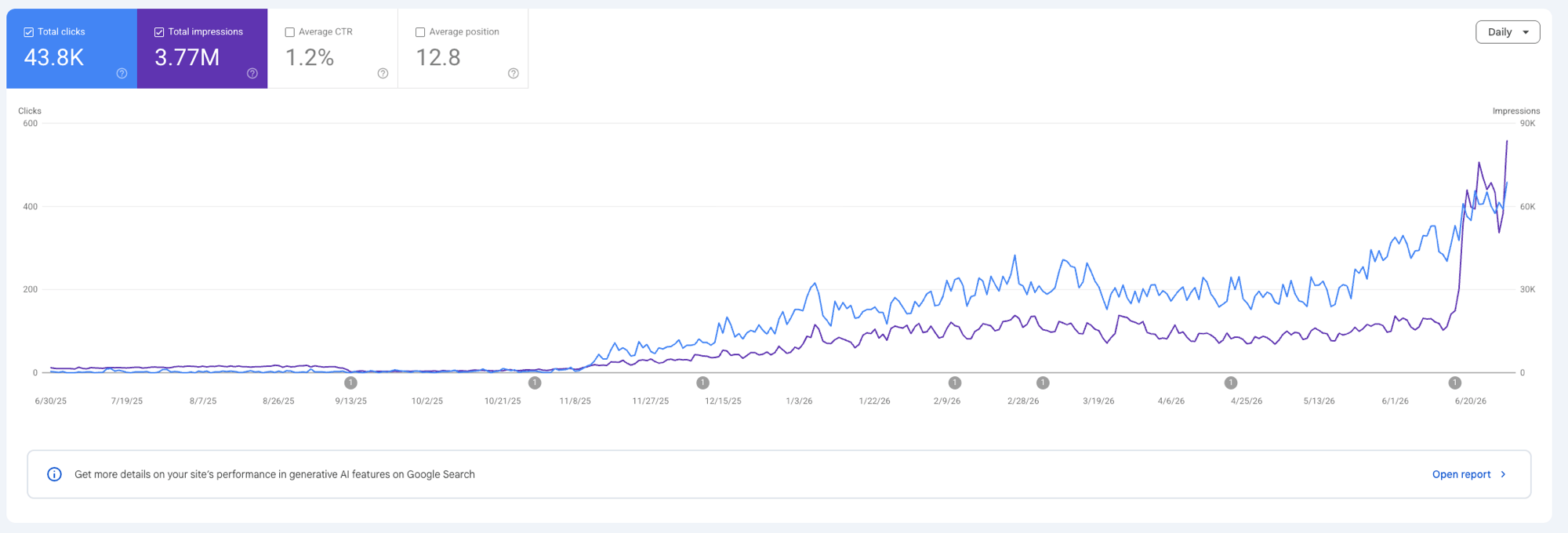
- Grew PBX.IM from ~22 organic clicks a month (position 55–60) to nearly 1M impressions and 6,000–9,000 clicks a month in roughly eight months
- Programmatic virtual-phone-number and area-code pages drove a 1,371% jump in organic clicks in a single month (109 → 1,603), reaching 10,101 clicks a month seven months later
- Prioritized bottom-of-funnel, buying-intent keywords over top-of-funnel content so the work translated into MQLs, not just traffic
- Fixed the foundations first — a technical audit, semantic HTML, internal linking, canonicals, and page speed — before scaling content
- Learned that optimizing standalone feature pages barely moved the needle; proper topic clusters did
- The core lesson: programmatic SEO only works when there is real, proven demand under every page you build
Introduction
Most SEO growth stories skip the part that actually matters — the specific decisions behind the numbers. We wanted to write one that doesn’t.
PBX.IM is one of our clients. It’s a cloud PBX and business communications platform built for SMBs, covering VoIP, SMS, call flows, and everything else a growing team needs to run its phone system online.
Eight months ago, the site was averaging position 55 to 60 in search. Today it pulls in close to a million impressions a month. We wanted to write this article because numbers like that tend to get treated as luck or magic, and neither is true. There’s a specific set of decisions behind that growth: what to build first, what to deliberately skip, and how to tell a real opportunity from a shiny distraction.
So we sat down with Karolina Knapik (Karo), our Senior SEO Specialist, and asked her to walk through the whole process. What she found first, what she chose to build, what failed, and what she’d do differently.
Here’s the story behind the numbers.
Origin and starting point
Q: When you took over, the site was averaging roughly position 55 to 60 in search and pulling only about 30 to 110 organic clicks a month through the middle of 2025. Was that the baseline you inherited, and what was your first read on why it was sitting that low?
I started working on the PBX.IM website in February 2025, when it was getting 22 organic clicks a month. It was a young site with only a handful of pages: a few solutions and feature pages and some blog posts. The pages that did exist were not properly optimized for search. There were no topic clusters, no authority signals, and the blog posts were not well structured. The foundations a search engine needs to trust and rank a site were not there yet.
Q: What was the first gap or opportunity you spotted that nobody else on the team had flagged? Walk me through how you found it.
The virtual phone numbers and area code clusters, built as programmatic SEO pages. I found the opportunity through competitor analysis. Once we published them, organic clicks grew by 1,371% in a single month, from 109 to 1,603, and the cluster went on to reach 10,101 clicks a month seven months later.
Q: The area-code and virtual-number pages were already running as an SEO authority play before the growth happened. Did you build that page system, inherit it, or rebuild it, and what state was it actually in when you arrived?
I identified it, planned it, worked with the team to build it, and released it.
Q: What did you choose to fix first, and why that instead of something else? What did your first 90 days actually look like day to day?
First, a technical audit. If pages are not being crawled and indexed, no further optimization makes sense. Once the technical side was clean, I moved on to understanding the core positioning, the buyer persona, and the business model, then ran keyword research and competitor analysis. From there I focused on quick wins: optimizing existing pages and identifying new bottom-of-funnel pages that would actually move the company toward its goals.
Q: Was anything broken at a technical or structural level (indexing, site architecture, how pages were templated) that was capping results before content quality even mattered?
Yes. There were indexing issues caused by weak internal linking. The HTML was not semantic, with missing H2s and no clear heading hierarchy. There was no authority signal, for example authored blog posts. Page speed needed work, and the canonicals were set incorrectly.
Strategy and decision-making
Q: The single biggest organic page on the site today is the China virtual-numbers page, /services/virtual-phone-numbers/cn, doing over 3,000 clicks a quarter, and the whole virtual-phone-numbers cluster is roughly three quarters of all organic clicks. Was that concentration the plan, or did the country-page system just take off faster than everything else?
Yes, it was intentional. The plan was to cover every country and own the virtual phone number cluster. PBX.IM offers numbers in countries that most competitors do not, so we could win those search results and attract customers who could not find that coverage elsewhere.
Q: You went hard on country-specific pages. What did you deliberately decide not to build or to deprioritize, and what did that tradeoff cost you?
We deliberately held back on informational, top-of-funnel content. The priority was bottom-of-funnel keywords first, the terms tied to buying intent, so the work translated into MQLs rather than just traffic.
Q: How do you actually decide which keywords and topics to chase? Give me one specific topic you green-lit and one you killed, and the reasoning behind each.
I base it on thorough competitor analysis, keyword research, and traffic potential, weighed against fit with the business and how well it scales. SEO and AEO visibility today depends on building clusters that prove the business is an expert in its niche. Clusters also let you build at scale, whereas standalone pages take far longer to deliver results.
Process and execution
Q: Take one page from blank to published. The SIP trunk providers guide, for example, now ranks around position 8 with about 83,000 impressions a quarter. Who researched it, who wrote it, who reviewed it, and how long did it take?
I start by researching the topic against client needs and the buyer persona, then move into keyword research and SERP and competitor analysis. From there I propose a structure for the blog post or landing page: the topics to cover, the points that have to be included, and a fresh angle that adds real value rather than repeating what is already ranking. I hand that to the copywriter, then do a final SEO review, add images and infographics, and publish, including the schema markup at the end.
Q: You work with Liza on copy, Daniel on design, and Igor on the paid side. Where do the handoffs happen cleanly, and where do they break?
We have a clear workflow and collaborate closely, supporting each other through the process.
Q: The country-page system is templated at scale. How much of it is genuinely automated versus hand-written, and what do you do to keep templated pages from reading like spam to Google?
It is one hand-written template. We define variables that are pulled automatically from the backend, and the content is written so it fits each case and adds unique value. The most important factors are intent and real demand for these pages. Without genuine demand there is no point building pages at scale. Beyond that, every page has to give the user something useful.
Q: What tool or workflow mattered most to the results, and what did you stop using because it was not earning its place?
Ahrefs, Semrush, and Google Search Console matter most. They tell us about demand, keywords, competitor traffic, and how users actually find us. I also use Claude for automation.
Results and proof
Q: The clearest inflection in the data is October to November 2025, when organic clicks jumped from about 109 to about 1,095 in a single month and average position moved from 28 to 16. What happened that month? Was it one change or several landing at once?
We published the virtual phone number pages all at once. That covered the search intent behind a large set of keywords, and the site started ranking for them quickly.
Q: From spring 2025 to now, impressions went from roughly 12,000 a month to nearly a million, clicks went from double digits to the 6,000 to 9,000 range, and the site moved from page five or six to page one on average. Put a timeline on that. How long did the meaningful part take, and at what point did you know it was working rather than noise?
It took about three months to audit the site properly, implement quick wins, work through the technical issues with the developers, and really understand the business and the buyer persona, including studying what competitors were doing at scale that was worth repeating. After that, it took roughly another three months to build the scalable system for the virtual phone numbers in [country] pages. The implementation was the part that took the most time.
Q: What was an early failure, a page or bet you were sure would rank and it just did not?
Optimizing the feature pages on their own, without supporting blog posts. My first instinct was to improve the pages we already had and treat that as the low-hanging fruit, without building related content around them. It moved the needle slightly, but not nearly as much as I expected. It was only when I went back and built proper clusters that the results came through.
Q: What was the most surprising win, a page or keyword that took off in a way you did not predict?
The SMS to Email feature. It is a single feature page with one supporting blog post, and it is a genuine differentiator against competitors. It performed far better than I expected.
Lessons and philosophy
Q: If you were dropped into another SMB SaaS company tomorrow with zero organic presence, what are the first three things you would do, in order?
First, truly understand the ICP, their problems, and their pain points. Second, start building at scale from the very beginning rather than treating it as a later phase. Third, optimize the existing content in parallel while that scaled system is being built.
Q: What do most people get wrong about SEO that you are now confident about?
Scaling pages with programmatic SEO is an easy, quick win. Without solid data behind it, it is not. Programmatic SEO only works when there is real, proven demand under every page you build.
Q: Knowing what you know now, what would you have done differently in your first six months at PBX.IM?
I would work more closely with the product team and the owner from the start, to understand the product in depth and exactly how the business makes money.
Q: How do you decide when a page is finished versus something you keep going back to improve?
It is all in the data. If the results are not satisfactory, there is always room to improve. A page is never really finished as long as the numbers say it can do better.
The person behind the strategy
Q: How did you end up in SEO in the first place? Deliberate, or did you fall into it?
I studied marketing and market communications for five years, and I knew I wanted to specialize in something I could do remotely, in a field with a strong future. That is how I landed on SEO.
Q: What is a moment from the last year that you were genuinely proud of?
The virtual phone number in [country] launch, without question. It gave me the confidence that my strategy works and can be repeated in another market.
Q: You are Polish, based in Malaga, working on a product sold mainly into the US and other English-speaking markets. Does working across that many languages and markets change how you see search?
Definitely. It pushes me to think big and on an international scale. It gives me a different perspective on how people in different countries search, which is rarely the same. It has also taught me how to do international SEO and position a website for several markets at once.
Q: With AI answers changing how people search, what is one thing about the next year that worries you and one thing that excites you?
What worries me is how fast everything is changing, and the challenge of separating the noise from what actually matters. What excites me is that there is always something new to learn, and that the work that delivers real value will win in the long run. Quality is the foundation I stick to.
What this means for you
Karo’s approach comes down to a few things: real demand before scale, bottom-of-funnel before top-of-funnel, and data over instinct when deciding what to fix next. The virtual phone number cluster proved the model works. Now it’s a matter of repeating it.
But SEO is one piece of a bigger picture. What you’re seeing here is Karo’s approach to search, but our marketing team works as a full unit — SEO, copy, design, and paid, all moving together. That’s the kind of setup that can take a business from zero and actually scale it, not just rank a few pages.
Want the full picture of what we built for PBX.IM beyond search? Read the complete PBX.IM case study — the cloud phone platform we took from zero to 750 clients in 11 months.
If that sounds like what your business needs, see how FOUND can grow your search and AI visibility.

Author
Liza Bazilevici
Creates content at BinarCode, helping translate technical expertise into clear, useful stories for founders, product teams, and decision-makers. Her work makes topics like software development, AI, and product scaling easier to navigate and more connected to real business goals.