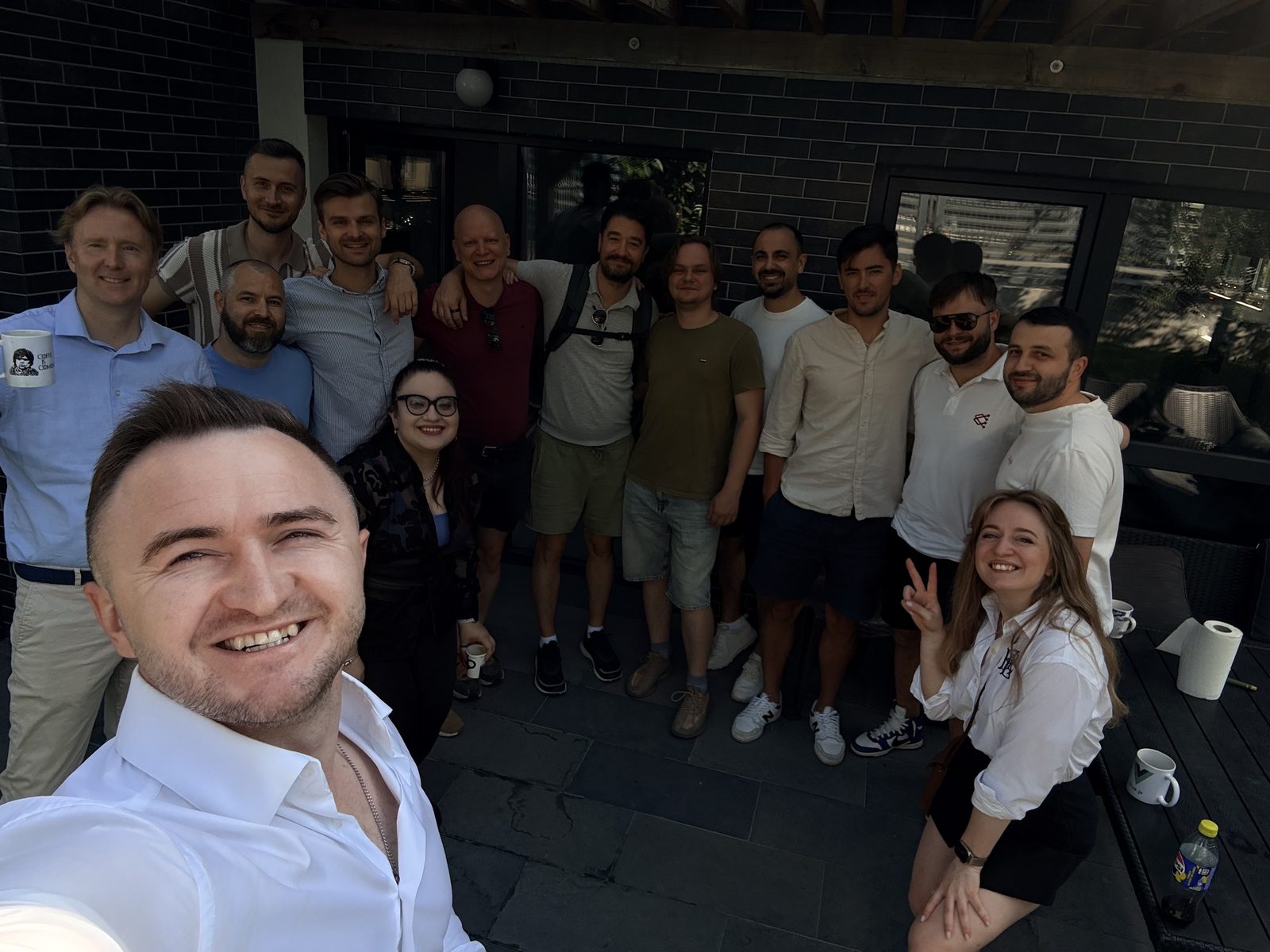
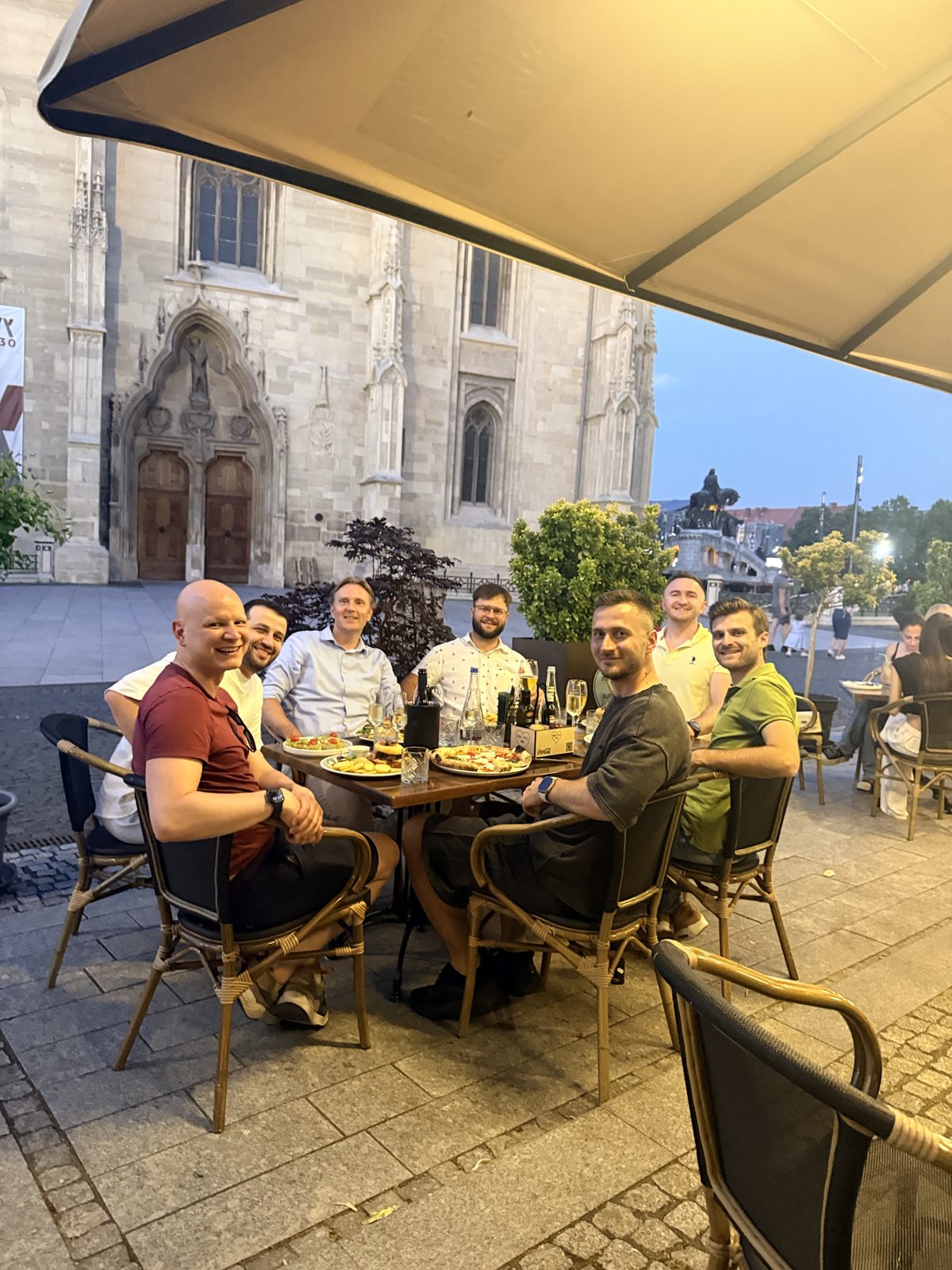
I run BinarCode, a 30 person software company in Cluj-Napoca. This week one of our oldest clients, a team from the Netherlands we have built with for years, flew in and spent two days in our office. There was no launch to save, no fire to put out, no contract to renegotiate. They came to think with us about where their product goes next.
I want to write about that visit honestly, because it is the clearest example I have of something that is hard to put on a services page: a good software partner now does far more than write the code you asked for. Somewhere in the last two years the job quietly changed. Choosing an AI agent development company stopped being about who can ship a feature fastest. It became about who can help you become an AI-first company without setting the system you already depend on on fire.
Here is what we actually talked about over those two days, and why I think it is the real work now.
Why a client flies in for two days
You do not get on a plane for a status update. You can do that on a call. You fly in when the conversation is big enough that you want to be in the same room, draw on the same whiteboard, and read each other’s faces when someone says “honestly, that part is not working.”
That is the part I value most about long-term partnerships. There is enough trust to be blunt about what is broken and ambitious about what could be, without anyone getting defensive. We have shipped enough together that nobody has to perform. We could spend the first hour on the uncomfortable truths instead of the polite warm-up.
The agenda almost wrote itself, and looking at it later I realized it was a near-perfect description of what clients actually need from us in 2026:
- How to prepare the codebase for an AI-first architecture
- What needs to change on the website and in the internal workflows
- Which AI agents are worth building now, and which can wait
- How to build a company second brain that works across departments, not just one team
Not one of those is “write me this feature.” Every one of them is strategy first, code second.
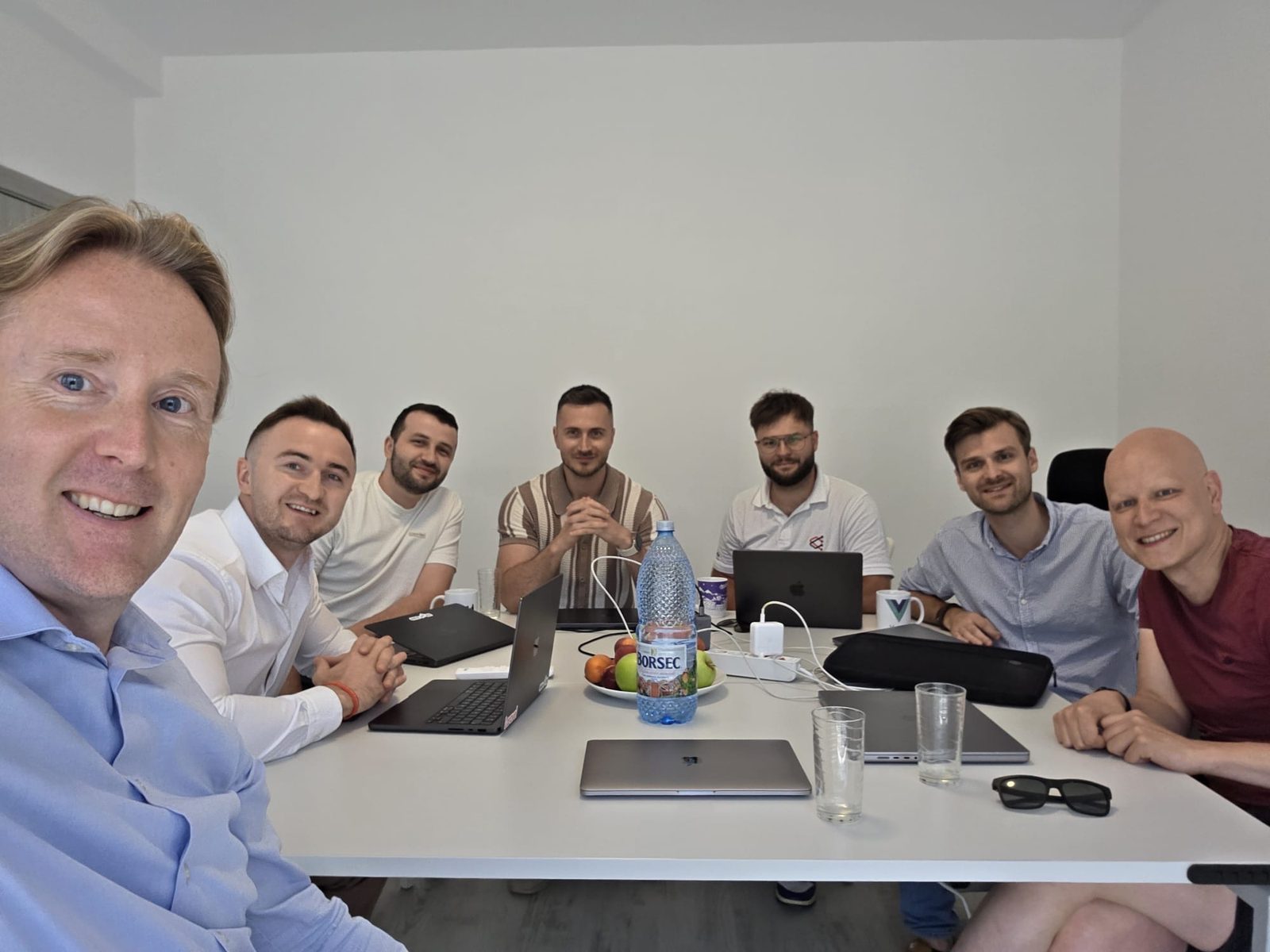
The agenda was only the frame. What we actually spent two days on was building the strategy for the rest of the year and the roadmap to deliver it. It was not a pivot. It was a refocus: sharpening what the business is really for over the next two to three years, and deciding what to build, and in what order, to get there.
A few of the calls we made together say more about how we work than any feature list could:
- Intelligence as infrastructure, not a bolt-on. The most important decision was a posture, not a tool. AI does not get added to the corner of the product later. It belongs in the core, in the architecture, from the start. That single reframe rewrote half the roadmap.
- Open up on the data layer. Instead of guarding everything behind a wall, the plan is to open the platform through a clean API and an MCP server, so partners and their own AI agents can build on top of infrastructure that took years to get right, instead of rebuilding it badly.
- Build the trust moat on purpose. Some of the most valuable roadmap items are not features at all. They are the certification path, privacy by design, and the unglamorous platform stability that lets you stand behind a real service level agreement. The architecture choices that support that have to be made now, so we made them now.
- Turn one expert’s instinct into an agent. The sharpest knowledge in any company lives in one or two people’s heads. We mapped how to write it down as a documented runbook first, then turn it into an agent that handles a whole category of work in parallel with them, with a human still pressing go.
We planned it bottom-up this year, from the foundation that already exists, rather than top-down from one ambitious number. If every part of the business gets one percent better each month, you roughly double in a year. That was the mood in the room: not a moonshot, a compounding plan everyone actually believed in.
”AI-first” is an infrastructure decision, not a slogan
The first item set the tone for everything else. “AI-first” gets used as a marketing line, and most of the time it means “we bolted a chatbot onto the corner of the dashboard.” That is not what we spent the morning on.
Becoming an AI-first company is an infrastructure decision. Before any agent can do anything useful, your data has to be reachable, your codebase has to expose clean interfaces, and your team has to know which problems are actually worth pointing a model at. So we did the unglamorous part: we looked at the existing architecture and asked where it is ready, where it would fight us, and what we would change first to make the whole system legible to an AI.
The honest answer is usually “less than you think, but in specific places.” A good partner tells you what to change and, just as importantly, what to leave alone. That is the conversation we have started running as a dedicated AI readiness audit, because clients kept asking for it: a clear-eyed look at whether your codebase and data are actually ready for what you want to build, before you spend a cent building it. The broader version of that work lives in our strategy and consulting practice, and it is the part people are surprised a “dev shop” even does.
Which AI agents to build now, and which can wait
The second item was the one where we earned our keep, and we did it mostly by saying no.
When a team gets excited about AI agents, the instinct is to build ten of them. The valuable move is to kill seven before they start. So we went through the list and sorted it ruthlessly: which agents pay for themselves in the first month, which are nice ideas that depend on data nobody has cleaned yet, and which are quietly a maintenance trap waiting to happen.
I can tell you what that looks like from the inside, because we run these for ourselves. We have an agent that triages inbound leads from Apollo and tells our sales team who is worth a reply. We have one that writes a daily report and drops it into Slack and Telegram before anyone is at their desk. None of these were impressive demos. They were boring, reliable, and they each removed a real chore. That is the bar. Good AI agent development services are less about the cleverest possible agent and more about the discipline to build the three that matter and skip the twenty that do not. When we take this on for clients it runs through our custom AI agent development services, and the first deliverable is almost always a shorter list than the one we walked in with.
Build an MCP server so your software can talk to AI
Here is the technical unlock that made the rest of the agenda possible, and it is worth understanding even if you are not an engineer.
For an AI agent to do anything with your product, it needs a safe, structured way to reach your data and actions. The emerging standard for that is MCP, the Model Context Protocol. When you build an MCP server for your application, you are giving any AI assistant a clean, permissioned door into your system: read these records, trigger that action, nothing more. It turns “our software” into “our software that an agent can actually operate.”
This is where being a development company, not just a consultancy, matters. Most of our backends run on Laravel Restify, our open-source framework, and it lets us stand up a REST API and an MCP server from the same codebase. So making a client’s product “AI-readable” is usually not a rewrite. It is a capability we switch on, on top of code that already exists. If you want the deeper version of how we approach this, it is on our MCP server development page. The point I made to the client over coffee was simple: the companies that expose their systems cleanly to AI now will have a year’s head start on the ones that treat it as a later problem.
A company second brain, not a wiki nobody opens
The fourth item was my favorite, because it is the one almost everyone gets wrong. Every company has a knowledge base. Almost none of them are alive. The wiki is six months stale, half the real decisions live in DMs, and the meeting where you decided the thing is a recording nobody will ever rewatch.
What we are after is different: a team knowledge base that both people and their AI agents read from. The single best AI knowledge base is the one your assistant actually pulls context from when you ask it a question, not the one your team is supposed to update and never does.
We have proof this works because we use it ourselves. Our team runs Routines, the Mac app we built, as a personal second brain. Notes, meeting summaries, and company context live locally as plain files that every routine and every chat can read.
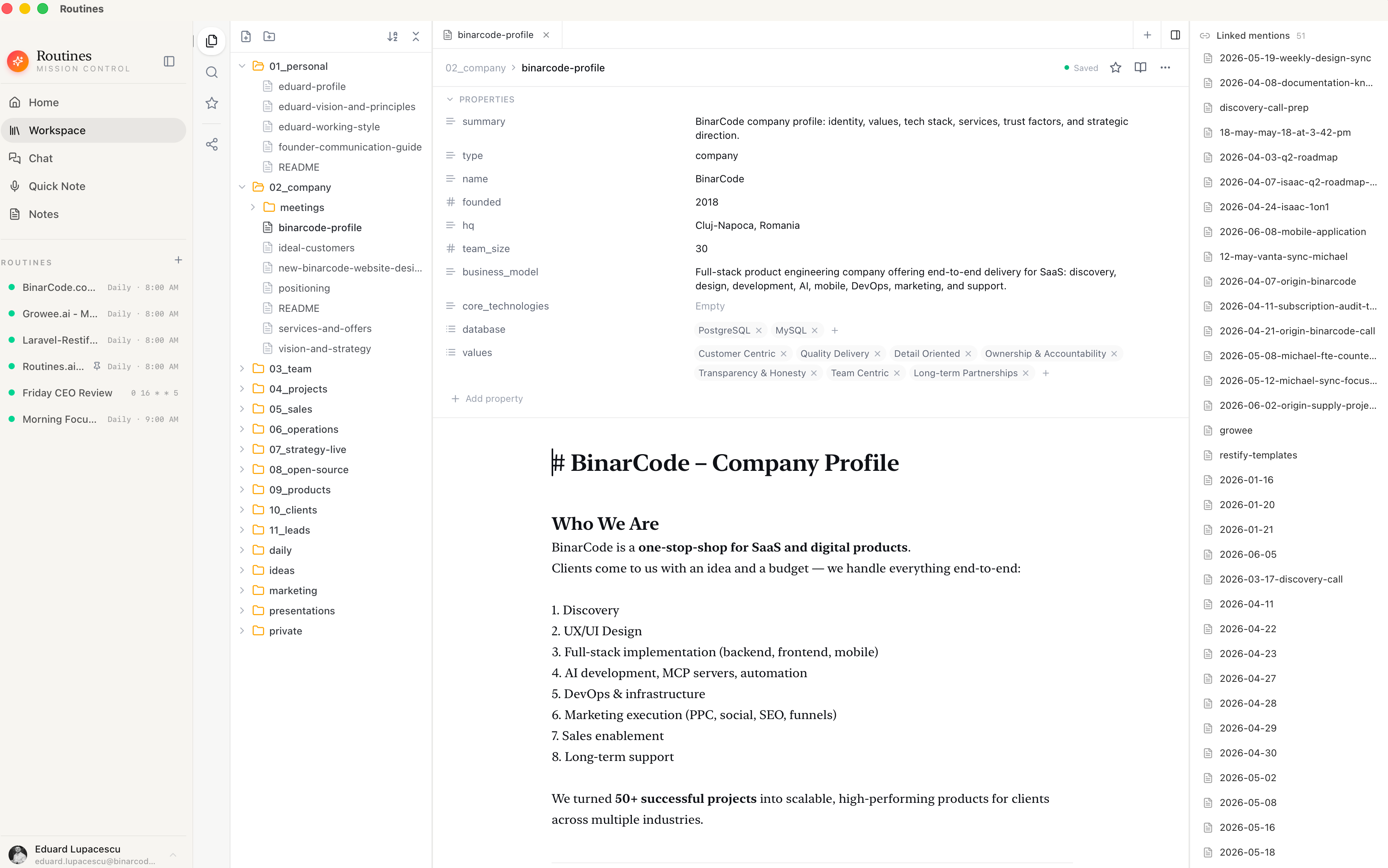
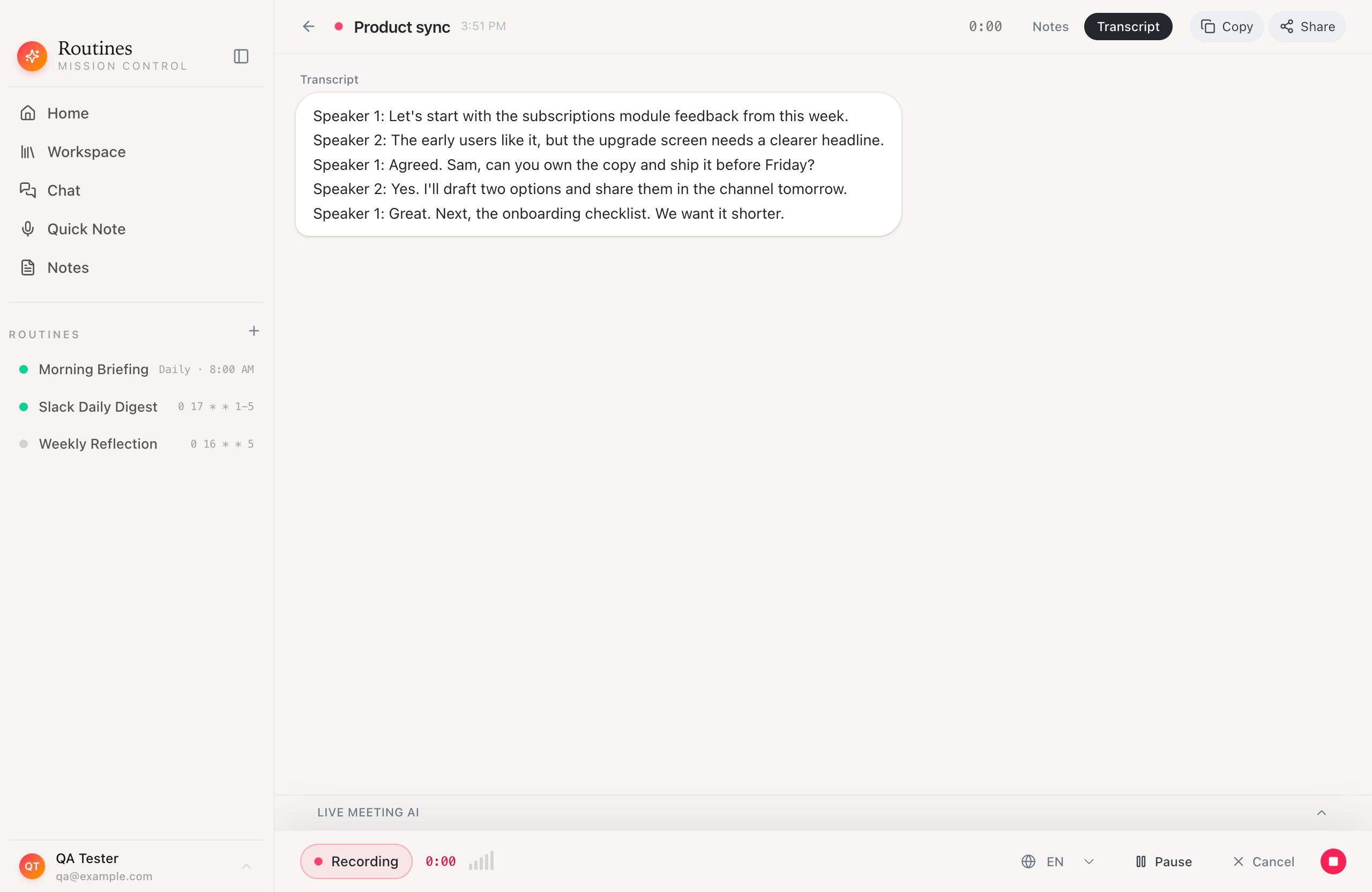
The piece that changed how my own week runs is meetings. A call gets recorded, transcribed, and summarized, and the summary lands in that memory as a note instead of dying in a tab. A week later I can ask “what did we decide about pricing” and get an answer from the actual meeting.
The leap we mapped out with the client is going from a personal second brain to a company-wide one: every department’s knowledge in one searchable place, with the right walls between teams, reachable by both humans and agents. That is exactly what we are building Gator for. If you want to design that from the documentation side, it connects to our work on smart documentation.
What changes on the website and in the workflows
This is the agenda item that surprises people, because it is where “we are a software company” turns into “we are a growth partner.”
Becoming AI-first is not only an engineering project. It shows up on your website and inside your day-to-day workflows. Your site has to say, in plain language, what you now do, or you will keep getting briefed for the old version of your company. Your internal processes, the ones marketing and sales and support run every day, are full of small repetitive tasks that an agent should be handling so your people can do the work only they can do.
That is why BinarCode is not only engineers. We have a marketing team that handles positioning, copywriting, campaigns, and the actual messaging, and increasingly they do it with AI marketing agents we built, plus workflow automation wired into the tools a team already lives in. During the visit we spent real time on the client’s site and funnel, not just their backend, because the two have to tell the same story. A product that became AI-first and a website that still describes last year’s company is a partnership that only did half the job.
So this is what an AI agent development company actually is now
By the end of the two days, the whiteboard was a mess and the plan was clear. Almost none of it was “build feature X.” It was: get the architecture ready, expose the system through an MCP server, build the two or three agents that earn their place, give the company a second brain that people and agents both use, and make the website and the workflows match the company they are becoming.
That is the honest definition of an AI agent development company in 2026, at least the one I want BinarCode to live up to. Not a team that takes a spec and returns code. A software development partner that helps you decide what is worth building, builds it well, and stays in the room while the company changes shape around it. The code is still the hard, real part. It is just no longer the whole job.
Long-term partnerships are useful for exactly this kind of conversation. There was enough trust to be honest about what is not working and ambitious about what could be. Good session. Now we get back to work.
If you are weighing what becoming AI-first would actually take for your product, that is the conversation we like having. You can start with an AI readiness audit or just tell us what you are trying to build, and we will tell you what we would do first.

Author
Eduard Lupacescu
Leads BinarCode's vision and growth, with over 12 years building software products and teams. Focused on turning client challenges across Western Europe, the US, and Israel into reliable, business-driven engineering outcomes.