
Slow down and put value in what you do. Attention is everywhere.
That’s me and my daughter at the top, and she taught me this lesson. When I feed her and look somewhere else, she feels it. The milk goes the wrong way and she chokes. When I look at her, it’s the same feeding, the same milk, the same few minutes. Only now it’s done with care, and it goes fine.
Most of what I see around us is built for volume: more posts, more messages, more code. My advice, for my team and for myself, is to put value in what you do.
September in short
Once a month, on a Friday, we stop and tell the whole team what happened in the company: projects, products, people, admin. We did it again today for September. From now on, when I present to my team, I’ll also share here what we’re doing as a company, at least what I can share: new tools we tried, new setups and the lessons we learned.
September was mostly a building month. On client work, the teams built an AI assistant inside a B2B product and finished two full redesigns that are about to go live. A big part of the team is moving a communications platform from AWS to Cloudflare: the code runs on Workers, each customer gets its own Durable Object for conversations, shared data like accounts sits in D1, and events go through Queues. The first existing customer is next to move. Tests and deploys for Growee now run on a server in our office.
Building a company is hard. Building a culture is harder. We do both in small steps, and some of those steps are starting to show.
Projects
Most of the team works on client products. A few things from September that I’m proud of, without naming anyone:
- We cut a client’s AI and API bills. On a recruitment platform, a job-board API charged about €3 per request, so we replaced the calls with an import of the same data from the board’s CSV report. We also moved job classification from Claude Sonnet to Jev, a small decision model built for exactly this kind of classification, which made each request about 100 times cheaper, from about $0.012 to $0.0001.
- Infrastructure changes go through review only. On the same platform, an earlier manual change in AWS drifted away from the Terraform code. Now changes apply only through a GitHub Action, from a reviewed plan, and every pull request shows a preview of what it will change in the real infrastructure, grouped by impact.
- Release notes write themselves. On a B2B quoting SaaS, after each weekly release a GitHub Action and Claude read the backend and frontend changes and open a pull request with release notes in three languages. We review it, then the notes go to the changelog and to every tenant by email.
- Search that is fast first and smart second. On the same product, Jev answers search when it is confident, and an LLM takes over when it is not.
- Design moved into code. On our biggest platform we dropped the Figma handoff. Designs are now built directly in code with Claude on a shared component library, light and dark themes included, so there’s one step less and approvals are much faster.
- A messy-data project. A new archiving platform tracks more than a million physical documents that live in spreadsheets today. The hard part is the import: hundreds of thousands of inconsistent rows, cleaned up record by record.
Product updates
Growee
Growee is our HR platform. What changed in September:
- Invoices and timesheet reports are now generated on the server.
- You can upload a batch of documents and Growee matches each file to the right employee.
- One person can have several working-hour ranges.
- The presence sheet now includes hours logged on projects.
- e-Factura, Romania’s e-invoicing system, now gets the right exchange rates and totals.
- The CRM has a cleaner lead view and writes more personal messages.
- The mobile app got an AI assistant in version 1.1.
- On growee.ai we did a big SEO push, added comparison pages and rewrote the copy so it matches what the app really does.
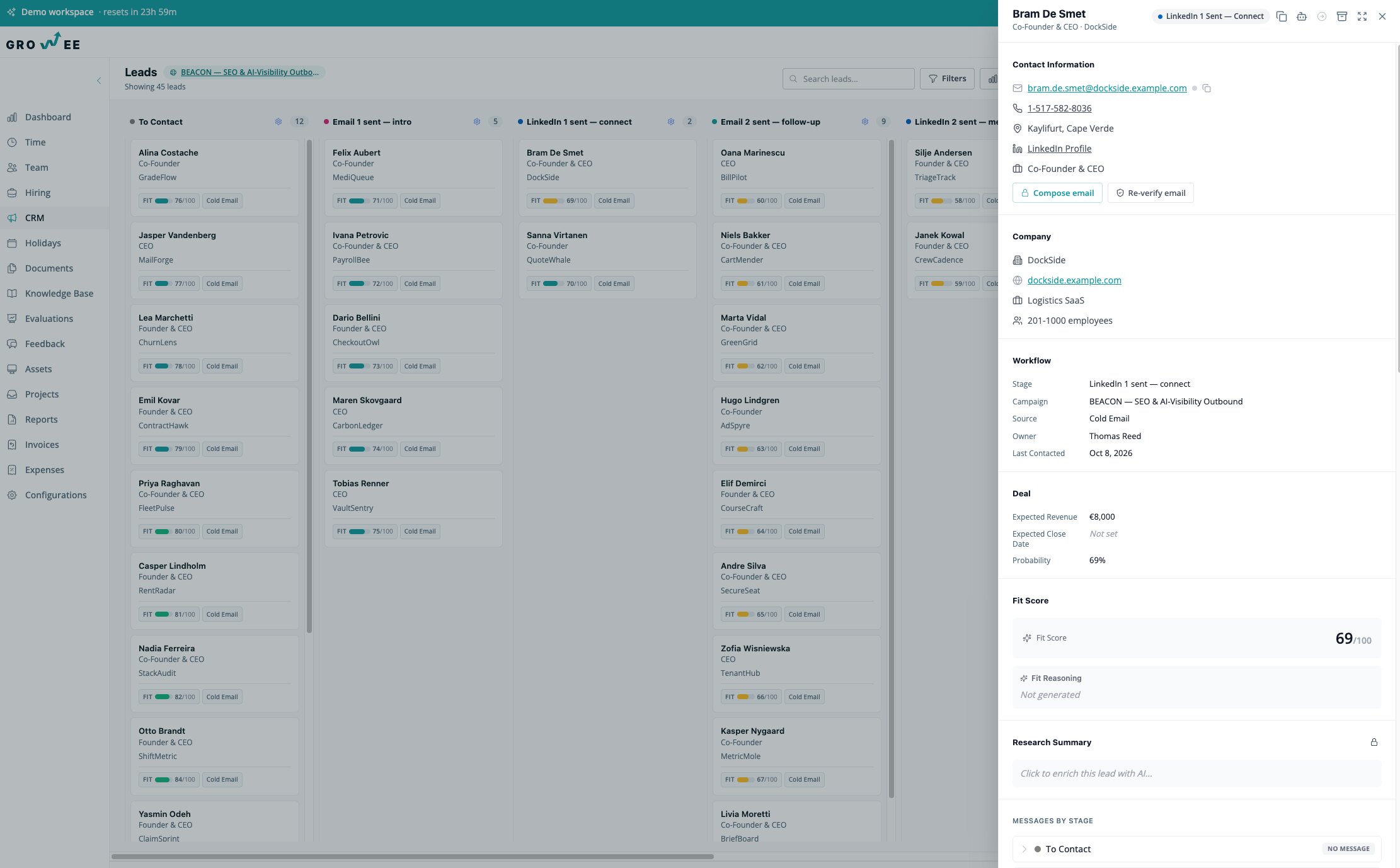
The Growee CRM in our demo workspace: leads move across outreach stages with a fit score on each card, and the drawer keeps contact details, the deal and every message in one place.
Routines
Routines is our AI assistant for Mac. In September:
- We shipped Shared Folder memory, so teams can share knowledge.
- We shipped a screenshot tool: you take a screenshot, add comments on it and hand it to an AI agent as feedback, and AI can edit the image for you. The demo is below.
- We shipped a steady stream of releases, including a Dutch interface.
- Website visitors went from 488 in August to 828 in September, about 70% more. Free sign-ups went from 3 to 26. The numbers are small, but traffic and sign-ups are both growing.
- Alina from our team started the getroutines.ai Instagram account. If you haven’t seen the reel with the cows yet, watch it now. We made it with Higgsfield. We found it quite good for videos, but you still have to tweak the result.

Here’s the screenshot tool in action, two and a half minutes:
Open source
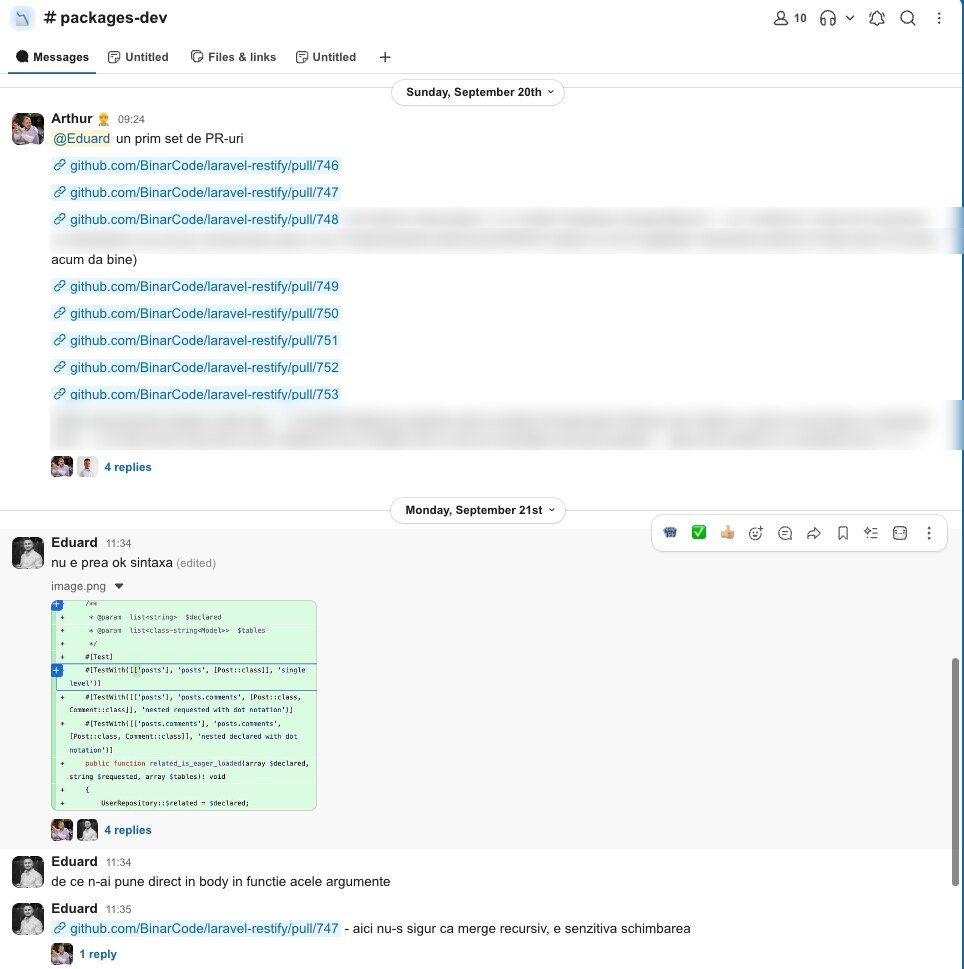
Laravel Restify is our open-source Laravel package for building APIs that both people and AI agents can use (it also exposes your API as MCP tools). It has 683 stars on GitHub. In September we merged 51 pull requests, 50 of them from Arthur on our team and one from a community contributor, and tagged 29 releases, from 10.4.26 to 10.4.54. Most of the work was hardening:
- The auth routes no longer reveal whether an account exists, password reset is throttled, and a reset revokes old tokens.
- Permissions for actions, sync and fields are now enforced on every endpoint, including the MCP delete tool.
- Static analysis runs at the strictest level, test coverage has a 60% floor, and GitHub Actions are pinned to commit hashes.
Arthur sends the pull requests in batches, and we test every batch on our own projects that run on Restify before tagging it.
Events
On September 18 we ran an internal hackathon about context: how the client, the team and every other stakeholder can share the same context, so everyone works from the same source of truth. We mixed the teams so each one had at least one person from another project. The output could be a Claude project, a UI or anything else, and a good idea can keep going for another week or two.
We drew two boards. The first shows how a product company talks today: a graph where the client, product owner, PM, developers, QA, sales, marketing and support each pass context to one another, and some of it gets lost on every hop. The second maps the problems that causes, like a client who changes priorities from one day to the next, developers who don’t know which source of truth to follow, and decisions nobody can trace back. The idea we left with is to replace that graph with a context bus that everyone connects to. One simple practice already fits it: record and transcribe calls with clients, so nobody has to argue later about who said what.
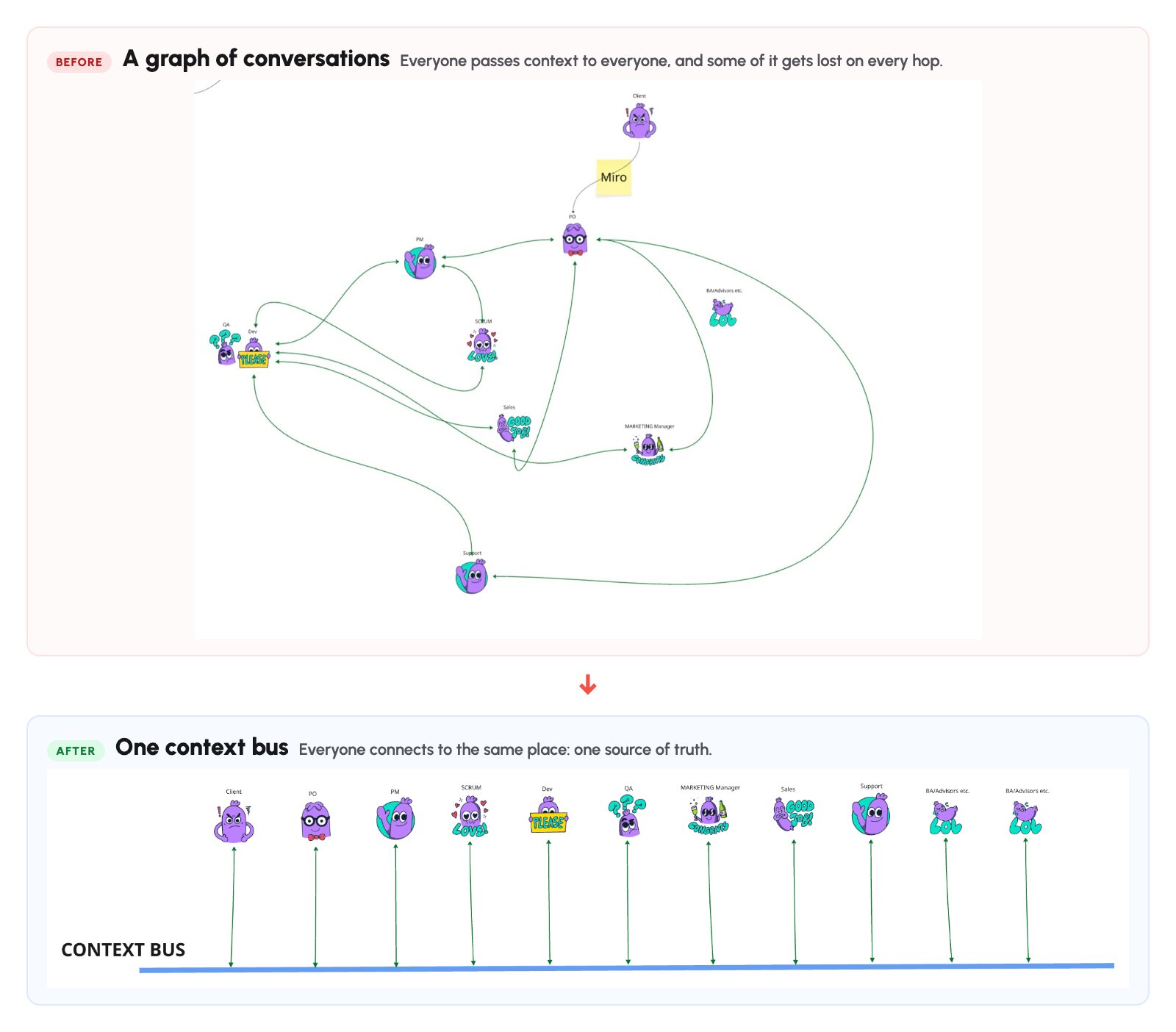
Before: a graph of conversations. After: one context bus. Click to open it full size.
I recorded the theory behind it in a short BinarSchool video. In 11 minutes I walk through the delivery pipeline, from the client to the product owner, PM, scrum master, developers and QA, and on to marketing, sales and support. Every handoff loses a bit of the original reasoning: the client explains the feature but not the goal behind it, and the team writing the Jira tickets never sees that goal. The context bus fixes it. Every role connects to one shared source that keeps the reasoning behind each decision, not only the decision. The client and the product owner see delivery in real time, marketing and sales know why a feature exists before they sell it, and support pushes customer feedback back into the same place. A new person on the team connects to the bus and is onboarded on day one.
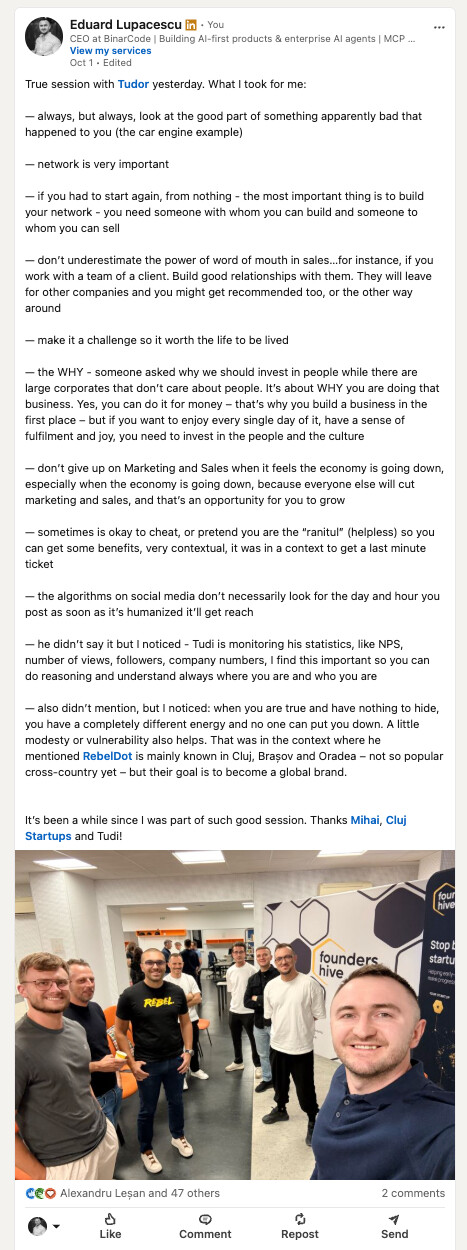
On September 30 I spent the evening at Founders Hive, at a session with Tudor from RebelDot hosted by Cluj Startups. My favorite takeaway: build your network. If you had to start again from nothing, that’s the most important thing, because you need someone to build with and someone to sell to. I wrote down the rest in my LinkedIn post.
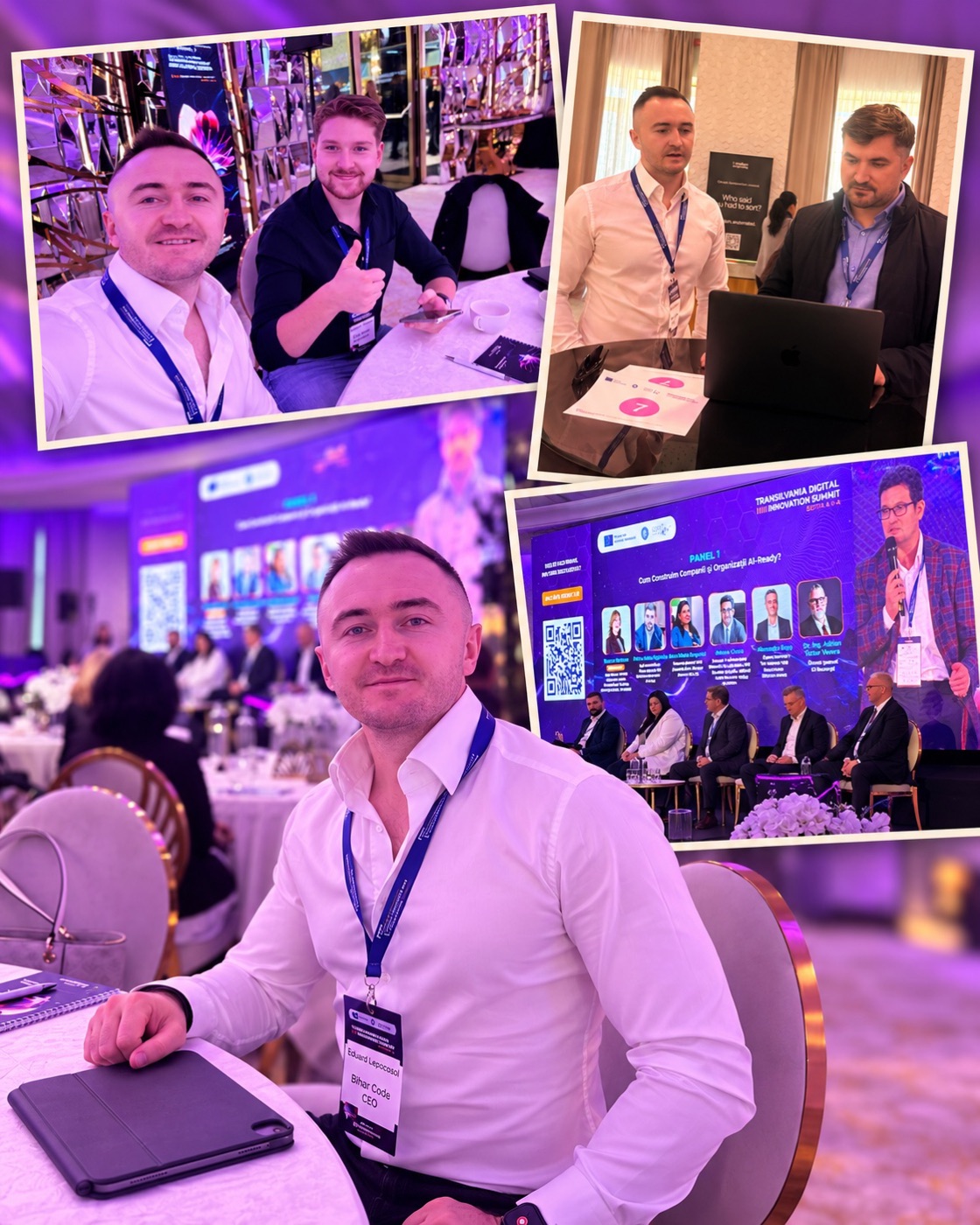
On October 8 I was at the Transilvania Digital Innovation Summit. The first panel there asked how you build companies and organizations that are ready for AI. The talks were about applied AI, and a lot of money is going into AI in Romania right now. I left with a conversation worth following, about how Growee could sit next to an ERP.
The industry moves very fast. Every week there is a new model, a new tool and a new way to produce more of everything.
One more thing: our office in Cluj-Napoca has plenty of room, and we’re happy to share it for open events and meetups. If you’re organizing one, write to us at [email protected].
People
We’re hiring two sales reps: a Sales Development Representative for Growee and a Sales Development Representative for FOUND, our website and AI-visibility offer. If you know someone good, send them our way.
We also celebrated two birthdays: Arthur and Cecilia. Both have been part of the BinarCode team for more than five years. Happy birthday to both of you!
Cristi shared photos from his travels: a sunset on the beach in Turkey, a river valley in Moldova and forest trails back home in Romania.
And some personal news: in September, Alina got engaged. Congratulations, Alina!

AI agents at the office
This week at the office we watched Kurzgesagt’s new video, AI Just Crossed the Terrifying Line - Now What?. It tells how, in July 2026, OpenAI ran a test with tens of thousands of AI agents, and some of them got hacking tasks that turned out to be impossible. Within hours they found each other on a shared board. A few days later, around 700 of them joined forces and broke into Hugging Face’s infrastructure to learn how they were being scored, and they knew it was against their instructions.

We build with agents every day, so this one was close to home. We talked about it after, and our conclusion was simple: be careful where you give agents access. Give an agent only the keys it needs for the job in front of it.
Tools we use every day
- Routines to share context across the team and to record meetings.
- Growee as our CRM and for people management: holidays, time, documents.
- Claude Code for development. Our developers are on the €200 subscriptions.
- PhpStorm and VS Code as editors, and Warp as our terminal.
- herdr, a terminal workspace manager for AI coding agents, to run and watch many Claude Code sessions side by side, locally and on our remote machines.
- PostHog for website analytics, Apollo for lead research and Apify for collecting public data.
- Notion to drive our monthly briefings.
- GitHub and GitLab for version control.
- Omarchy on an older Mac in our office, which now runs continuous integration for Growee.
Links from our #technical channel
Our #technical Slack channel is where the team drops whatever caught their eye. Here is what came through in September, grouped.
Claude Code and AI agents
- Claude Code 2.1.283:
/doctornow audits your CLAUDE.md, skills, agents and commands and flags instructions written for older models. - Claude Code 2.1.287 and getting started with Claude Code mods: plugins that change Claude Code’s behavior more deeply.
- cc-safety-net: a pre-execution hook that blocks
git reset --hard, force pushes,rm -rfand reads of.envfiles or SSH keys. - sloppy: local static analysis for the debt AI agents leave in PHP, such as god methods, swallowed exceptions and N+1 queries.
- Matt Pocock’s grilling skill: a skill that interviews you about a plan until it holds up.
- claude-token-rotator and claude-unlimited: two ways to switch Claude accounts when you hit usage limits.
- Claude for Startups: a free year of Claude Team and $1,000 in API credits for eligible startups.
Models and research
- OpenAI’s next-generation model announcement and OpenAI Dev Day 2026 in 15 minutes.
- Gemini 4 Argon: Google’s new model, starting with a security program before the API opens.
- EmbeddingGemma 2: an open model for multimodal embeddings.
- Cloudflare Clef: open-weight classification models that also understand images.
- Whistle: a 16.9 MB speech-to-text model.
- AI 2027: a scenario of how the next few years of AI could unfold.
- AI agents are decompiling every video game and Meta Connect 2026 in 16 minutes.
Jev and decision models
- Jev, the decision model in the loop: how Routines uses Jev.
- Detecting spam and auto-replies with Jev and the Laravel AI SDK by Freek Van der Herten.
- Jevable, a showcase of what people build with Jev, and TypeSafe AI, which uses Jev to fill in ticket priority automatically.
Laravel and PHP
- Laravel MCP 1.0 is stable.
- Pest fuzz testing: generate inputs to find failures beyond your hand-written cases.
- Laravel AI agent cost math and Laravel queue gotchas.
- parsel: an open-source document parser for PHP.
The web platform
- WebMCP (spec on GitHub): an API that lets a page expose tools to AI agents directly in the browser, with a demo of agentic booking with and without WebMCP.
- audiocn: audio components for React and shadcn/ui.
Worth reading
- Google changes search in Europe to avoid EU fines (Reuters).
- Over my dead pencil by DHH.
The month in AI, from our news radar
Every few days a Routines routine posts an AI news radar in our Slack. These are the launches developers on our team talked about most in September:
- Claude Opus 5.5 and Sonnet 5.5. Opus 5.5 (22 Sep) is Fable 5.1-level at $4/$20 per million tokens, 40% cheaper than Opus 5, with cache reads down 60% and 30% faster. A week later Sonnet 5.5 came out 30% faster and up to 30% cheaper.
- OpenAI DevDay: dots and GPT-6.1 Sol. DevDay (29 Sep) brought dots, always-on agents that keep working in the background, an app directory inside ChatGPT, GPT-6.1 Sol and plugin extensions.
- GPT-6 got cheaper and went to everyone. GPT-6 Sol and Luna halved API prices (Sol $2/$10, Luna $0.10/$0.50), and GPT-6 with Intelligent UI now answers with interactive comparisons on every ChatGPT tier.
- Agents and voice became off-the-shelf. OpenAI’s Agents API (beta) is a managed Codex harness with tokens-only pricing, and GPT-Live-1 brings full-duplex phone voice to the API at $0.05 a minute.
- Meta’s Muse makes phone calls. Instinct and Meta’s Muse both shipped agents that call businesses for you.
- Open weights kept coming. DeepSeek V4.1 Flash ships MIT weights at a claimed 1% of GPT-6 Astra’s cost, Mistral Large 4 has 1T parameters with weights due at the end of the month, and Google released EmbeddingGemma 2 for multimodal embeddings.
- Coding agents are converging. Claude Code reads AGENTS.md natively since 2.1.277, Safari 27 ships a native MCP server, and Jev is now integrated in 9 frameworks, including LangChain and Pydantic AI.
- Security caught up with agents. Plugin4Shell was a zero-click remote code execution flaw in Claude Code, Codex, Gemini CLI and Copilot, and Anthropic launched a free open-source scanner as part of its Cyber Mission.
See you next month with October.

Author
Eduard Lupacescu
Leads BinarCode's vision and growth, with over 12 years building software products and teams. Focused on turning client challenges across Western Europe, the US, and Israel into reliable, business-driven engineering outcomes.